
Intelligence requires its own hardware
Superconductors and light operate at the physical limits of AI. The result is 300x reduction on cost of LLM tokens and a million x lower cost for video analysis.
Conventional chips constrain intelligence
Silicon transistors representing binary digits are excellent for crunching numbers, but are not well matched to intelligence. Modern computer architectures separate information processing from memory storage, leading to excessive data movement. Communication within and between chips requires serial movement of data packets through congested routing networks. All these design choices make sense for general-purpose processors, but they’re poorly matched to the needs of intelligence.
Principles of intelligence, realized in hardware
Representing information as continuously varying analog signals instead of binary digits is a better substrate for the fluid operations of intelligence. Superconducting circuits based on Josephson junctions naturally support high-accuracy, low-noise analog computations. These circuits also seamlessly integrate processing and memory, storing synaptic weights right where they’re needed, eliminating the primary requirement for data movement in AI. For communication across large neural networks, light is ideal, and integrating photonics with superconductors is straightforward and performant. Our hardware combines analog superconducting circuits with distributed, dynamic memory and integrated-photonic communication. The result is a platform with extraordinary speed and energy efficiency, low cost of manufacturing, and a new pathway to exponential scaling.
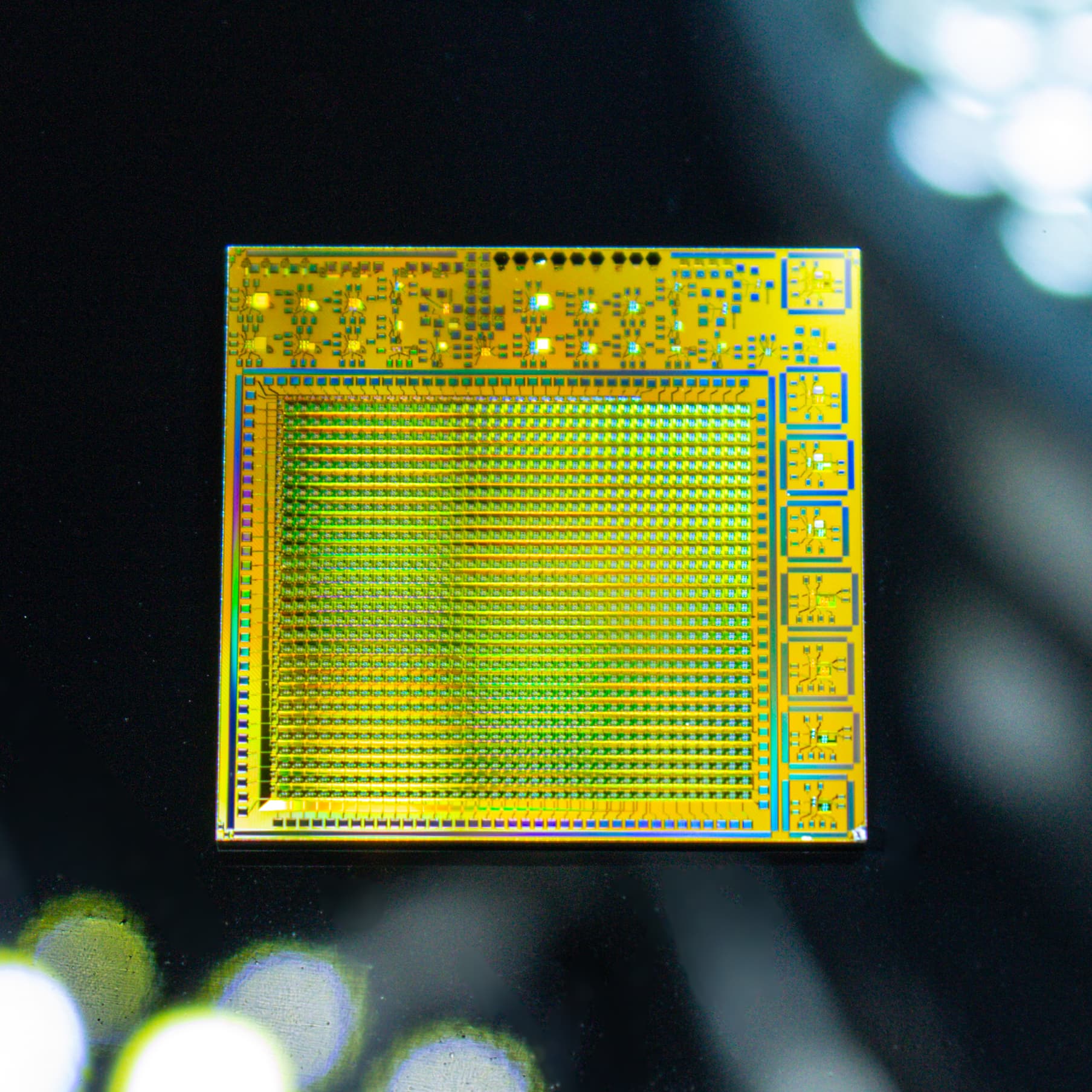
The Three-Part Architecture
Leveraging the complementary strengths of electrons and photons
Superconducting optoelectronic networks
We build superconducting optoelectronic networks — SOENs. These are the foundational principles.
Architecture
The most important principle of hardware for AI is that the architecture of neural networks must be physically instantiated in hardware. It isn't enough to digitally emulate what neurons and synapses do. Chips must be based on circuits that actually perform the operations of neurons, synapses, and their extensive interconnectivity.
Computation
Superconducting circuits are ideal for the purpose of functioning like neurons and synapses. The most prominent superconducting device is the Josephson junction, and simple circuits with two Josephson junctions naturally capture the behavior of these critical elements: they sum many inputs, they perform nonlinear transfer functions, and they implement synaptic weights. Josephson junctions have the highest speed-over-energy quotient of any circuit element, so there is no known way to compute faster with less energy.
Memory
For neural networks, the most important role of memory is to store synaptic weights. With superconducting circuits, it is straightforward to store synaptic weights right at the circuit that uses that information, eliminating the primary data-movement requirement in conventional computer architectures. Josephson circuits solve this problem inherently.
Communication
Neural networks require extensive connectivity — far beyond what can be achieved with copper wires directly. Using light for communication allows each neuron to make thousands of direct connections. Each of our neurons has its own light source and its own network of waveguides — tiny wires for light. Each synapse has a superconducting single-photon detector — the most sensitive light sensor in the world. With this approach, neurons achieve two physical limits: they communicate at the fastest speed in the universe, the speed of light; and they do this with the minimum possible optical energy — one photon per communication event.
Scalability
With these principles in place, we have a scalable architecture for profound intelligence. The exponential scaling of Moore's law has transformed society and fueled the economy for six decades. In that case, scaling was sustained through improvements in lithography as transistors were made smaller with each product generation. SOENs provide a new path to exponential growth — not by shrinking devices to the atomic scale, but by integrating ever more neural circuitry into larger systems. This is possible with Great Sky's hardware because of these principles: superconductors enable extreme speed with very low power density; they co-locate memory with processing to reduce data movement; and they communicate with single particles of light for extraordinary communication bandwidth while retaining energy efficiency. Our chips are manufactured on foundry nodes that were standard in 2005, keeping costs low, margins high, and making US production viable.
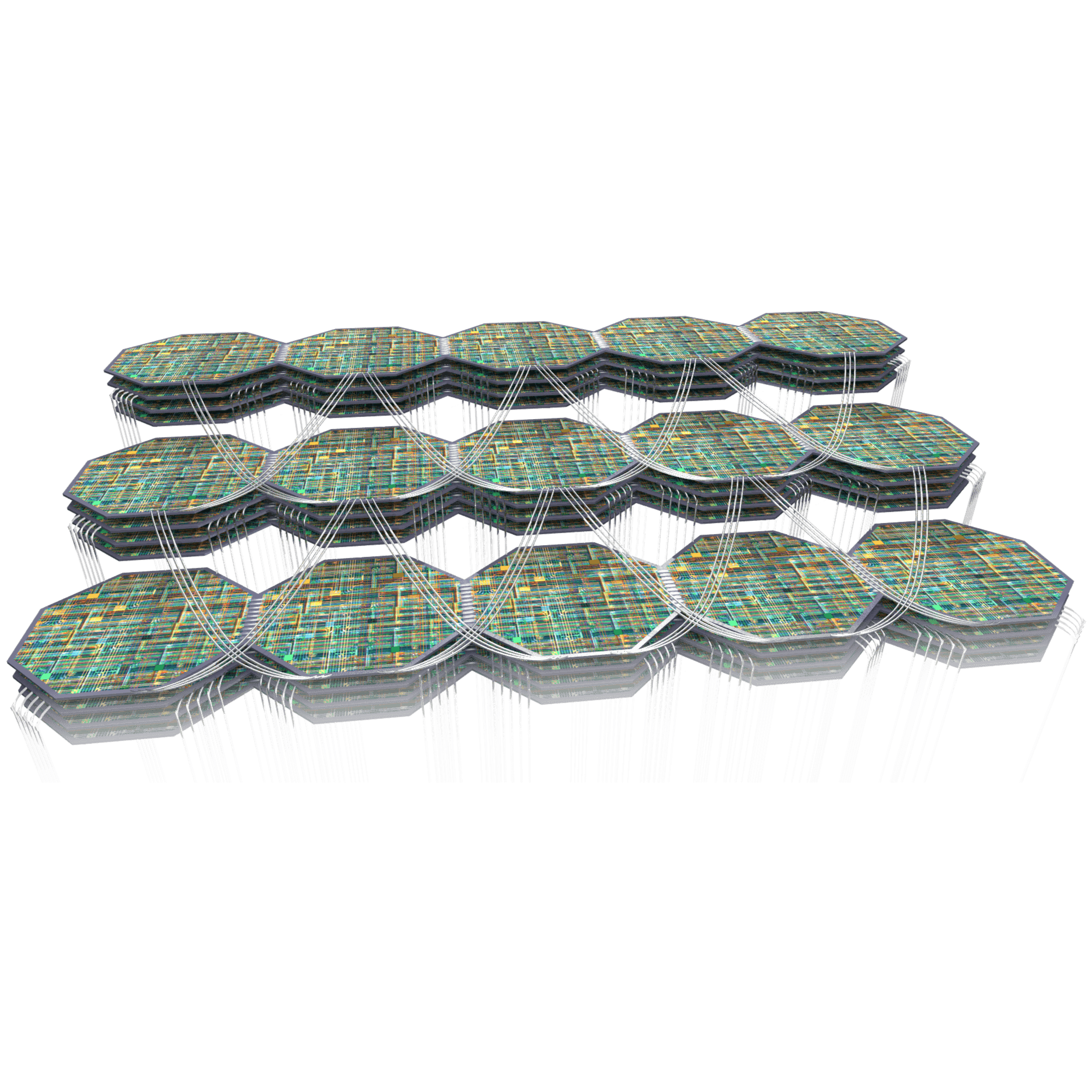
We're building the technology that will transform the economy for the next century.
Hardware and Architecture Transform the Numbers
All figures derived from experimental data and published research.
| METRIC | TODAY'S BEST AI HARDWARE | OUR ARCHITECTURE |
|---|---|---|
| Video inference speed | 30 frames per second | 60 million frames per second (2 million x improvement) |
| Video inference energy (10 min video) | 870,000 joules | 192 Joules (4,500 x improvement) |
| LLM cost per token | $3 per 1M output tokens | $0.01 per 1M output tokens (300x lower TCO) |
Contact us to try our chip.